Industrial Automation Solutions: Enabling Intelligence at the Edge

Industrial Automation Solutions Enabling Intelligence at the Edge1

Industrial automation is undergoing one of the most significant transformations in its history. Driven by the convergence of robotics, artificial intelligence (AI), Internet of Things (IoT), and edge computing, modern industrial systems are evolving from centralized, rigid architectures into distributed, intelligent ecosystems capable of real-time decision-making.

Across manufacturing, logistics, energy, agriculture, and infrastructure, organizations are increasingly adopting edge-first architectures, where data is processed locally rather than being sent to the cloud. This shift is not only about performance; it is about enabling autonomy, reducing latency, improving reliability, and operating efficiently in environments where connectivity may be limited or intermittent.

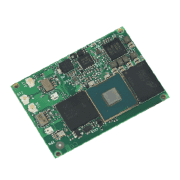
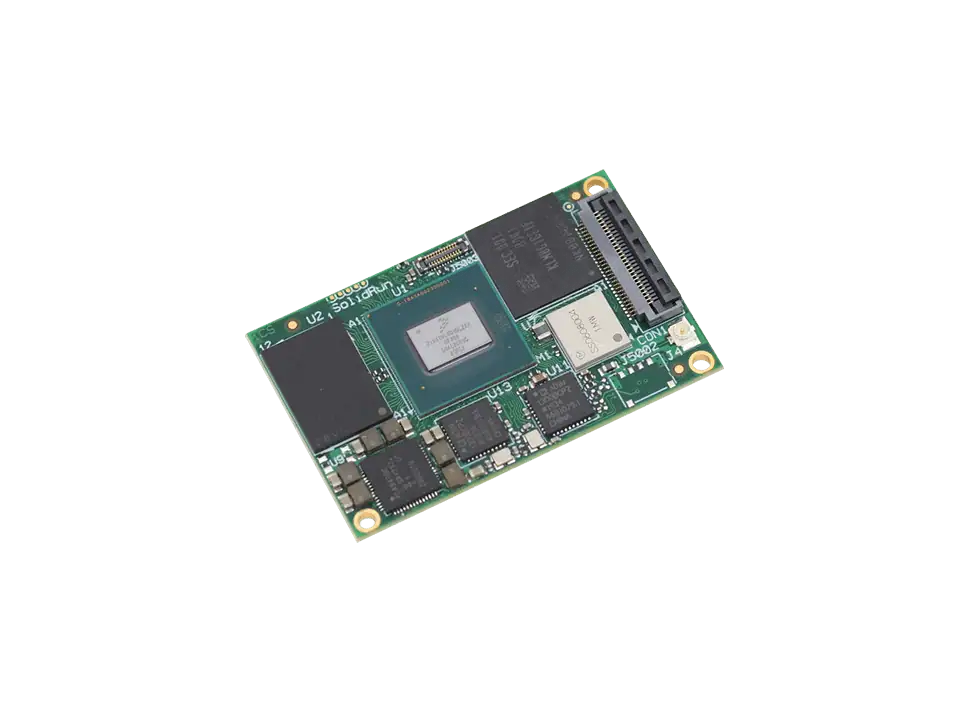
At the heart of this transformation lies a new generation of embedded computing platforms: low-power, compact, industrial-grade System-on-Modules (SoMs) that integrate CPU performance, AI acceleration, connectivity, and sensor processing into highly optimized form factors.

By providing advanced embedded edge computing building blocks, SolidRun enables OEMs and solution developers to rapidly design and deploy intelligent industrial systems. These platforms empower customers to bring AI-driven capabilities directly to machines, devices, and field systems operating in harsh and resource-constrained environments.

This article presents several real-world industrial automation use cases demonstrating how edge computing enables smarter, faster, and more resilient industrial systems.

Integrated 3D Sensor Systems with Machine Learning

The Challenge: Vision-Driven Automation at the Edge

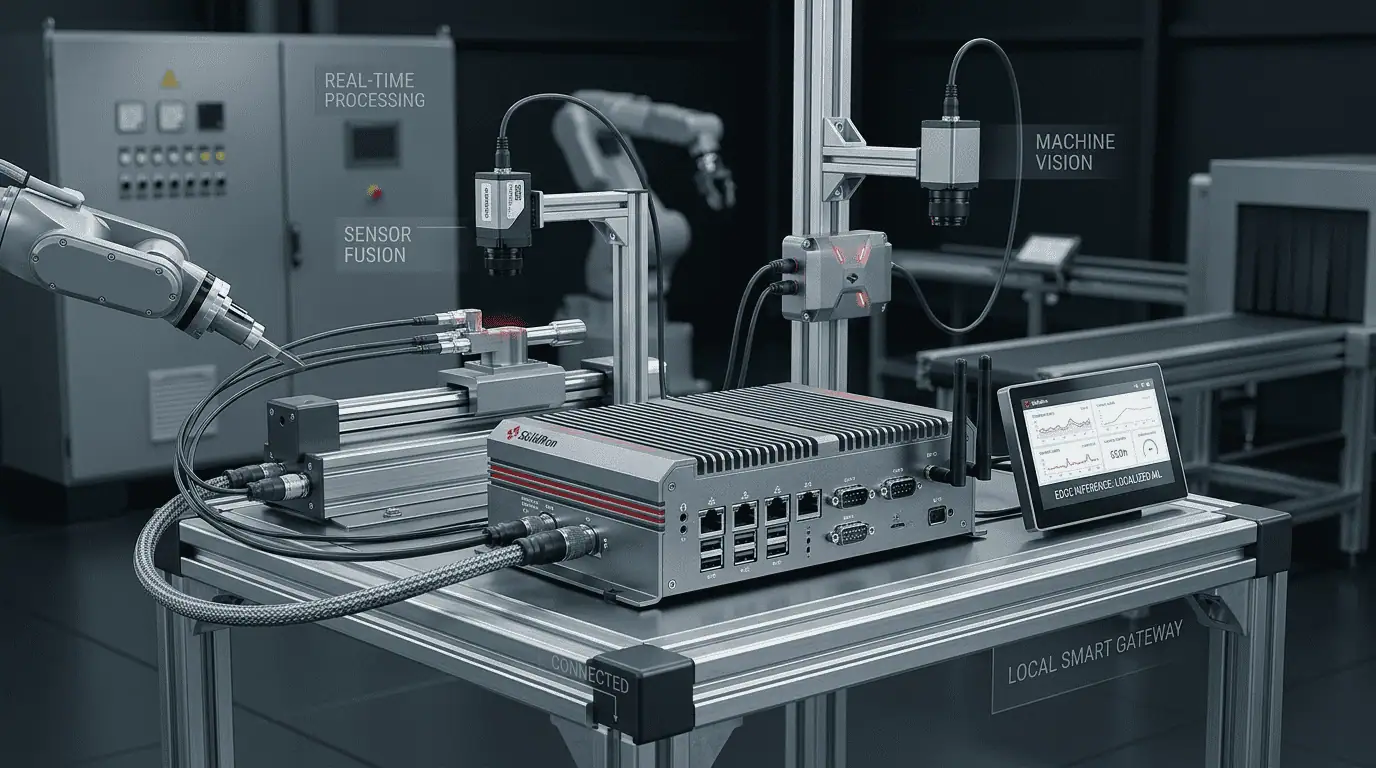
Modern Industry 4.0 applications increasingly rely on machine vision systems to guide robotics, ensure quality control, and enable autonomous decision-making. However, implementing advanced 3D vision systems introduces several challenges:

Traditional architectures often rely on cloud-based processing, which introduces unacceptable latency for real-time robotics applications. In addition, high-resolution image streams require significant bandwidth, increasing infrastructure cost and limiting scalability. Integrating depth sensing, image processing, and AI inference into a compact system further complicates hardware design, especially in industrial environments where space, power, and thermal constraints are strict.

To enable next-generation automation, industrial systems require compact, integrated platforms capable of processing visual data locally and in real time.

Evaluation Criteria

To meet the demands of modern machine vision systems, the solution must provide:

  • Real-time processing of 3D and depth sensor data
  • Low-latency AI inference at the edge
  • Compact hardware suitable for embedded robotics
  • Industrial-grade reliability under continuous operation
  • Support for multi-camera or advanced vision configurations

The Solution

A customized embedded vision system built on the i.MX8M Plus System on Module enables real-time machine learning inference directly on the device. The platform combines CPU performance with a dedicated neural processing unit (NPU), allowing efficient execution of computer vision workloads without reliance on external compute resources.

Integration Approach

SolidRun worked closely with the customer to develop a tailored hardware solution, including a custom carrier board designed specifically for industrial machine vision requirements. The design included:

  • Dual camera input support for stereoscopic or depth-based vision
  • Integrated storage and power management system
  • Optimized board layout for compact robotic systems
  • Edge AI acceleration using the onboard NPU

This tight hardware-software integration allowed the customer to deploy a fully autonomous vision system capable of operating directly within robotic platforms.

Outcomes and Benefits

The resulting solution delivered measurable improvements:

  • Significant reduction in processing latency due to local inference
  • Increased accuracy in object detection and spatial awareness
  • Reduced reliance on cloud infrastructure and network connectivity
  • Smaller system footprint, enabling integration into compact robotic devices
  • Lower total system cost through hardware consolidation

By bringing intelligence directly to the edge, the customer achieved faster decision-making and improved operational efficiency in automated industrial environments.

Next-Generation Autonomous Harvesting Robotics

The Challenge: Precision Agriculture in Complex Environments

Agriculture is undergoing a technological revolution driven by automation and AI. While drones have been widely used for monitoring crop health, soil conditions, and spraying applications, the next frontier is fully autonomous harvesting.

However, agricultural environments present unique challenges. Crops must be handled with precision to avoid damage, and harvesting decisions must be made in real time based on environmental conditions, plant maturity, and spatial positioning. These tasks require a combination of computer vision, AI inference, and motion control operating in highly dynamic outdoor environments.

Evaluation Criteria

An effective solution must support:

  • Autonomous decision-making using edge AI
  • Low-power operation suitable for airborne robotics
  • Real-time image processing under variable lighting conditions
  • Flexible hardware for custom robotics integration
  • High reliability in outdoor agricultural environments

The Solution

An autonomous agricultural robotics platform was developed using the i.MX8M Mini System on Module, providing an optimized balance between performance and energy efficiency.
The system enables onboard processing for navigation, object detection, and harvesting decision-making without relying on external connectivity.

Integration Approach

The customer designed a custom carrier board based on SolidRun reference schematics, enabling:

  • Integration of flight control systems and AI processing on a unified platform
  • Edge-based computer vision for crop detection and classification
  • Autonomous control loops for harvesting actions
  • Efficient power management for extended drone operation

Outcomes and Benefits

The implementation resulted in:

  • Increased harvesting precision with reduced crop damage
  • Improved autonomy in complex orchard environments
  • Reduced operational dependency on human labor
  • Extended mission duration due to low-power architecture
  • Faster development cycles through reference design reuse

This use case demonstrates how compact embedded systems enable entirely new classes of autonomous industrial robotics.

AI-Driven Food Dispensing Systems

The Challenge: Consistency, Waste, and Limited Intelligence

Traditional food dispensing systems operate as static machines with minimal adaptability. This leads to inconsistent portion control, inefficient inventory usage, and high levels of food waste. Additionally, maintenance is typically reactive rather than predictive, resulting in unnecessary downtime.

Modern food service and vending applications require intelligent systems capable of adapting in real time to user behavior, environmental conditions, and supply availability.

Evaluation Criteria

The solution must provide:

  • Real-time AI inference at ultra-low power
  • Integrated vision and sensor processing
  • Compact and fanless system design
  • Predictive maintenance capabilities
  • High reliability for continuous operation

The Solution

A smart dispensing system built on the Renesas RZ/V2L System on Module enables efficient edge AI processing in cost-sensitive industrial environments.
The platform integrates a DRP-AI accelerator and image processing capabilities, allowing real-time decision-making without external hardware dependencies.

Integration Approach

Key system design elements include:

  • On-device image recognition for portion verification
  • Embedded AI models for quality control
  • Integrated processing eliminating external ISP requirements
  • Compact architecture suitable for kiosks and vending systems
  • Industrial temperature support for continuous operation

Outcomes and Benefits

The system delivered:

  • Improved consistency in portion control
  • Reduced food waste through intelligent dispensing
  • Lower operational costs due to integrated architecture
  • Predictive maintenance capabilities reducing downtime
  • Enhanced personalization for end users

This represents a shift from mechanical dispensing systems to intelligent, adaptive food automation platforms.

Next-Generation Industrial Gateways

The Challenge: Real-Time Connectivity and Edge Intelligence

Industrial networks are becoming increasingly complex, requiring gateways that not only connect devices but also process data locally. Traditional architectures struggle to meet the demands of modern industrial systems, especially those involving high-bandwidth sensors, machine vision, and real-time control loops.
Latency, security, and scalability are key concerns, particularly in large distributed environments such as energy grids, water systems, and manufacturing plants.

Evaluation Criteria

Industrial gateways must support:

  • Sub-10ms real-time processing capability
  • Multi-protocol industrial connectivity
  • Edge AI inference for local decision-making
  • High-bandwidth data handling (e.g., video streams)
  • Secure and resilient network architectures

The Solution

An advanced industrial gateway platform based on the i.MX8M Plus System on Module integrates computing, AI, and connectivity into a unified edge system.

Integration Approach

The platform includes:

  • Quad-core Cortex-A53 CPU for application processing
  • Integrated NPU for AI inference (2.3 TOPS)
  • Cortex-M7 real-time core for deterministic control
  • Dual Gigabit Ethernet with TSN support
  • CAN-FD and camera input support for industrial sensing
  • Hardware security engines for trusted operations

Outcomes and Benefits

The solution enables:

  • Reduced latency in industrial control systems
  • Improved throughput for data-intensive applications
  • Enhanced system reliability in harsh environments
  • Stronger cybersecurity and system integrity
  • Simplified system architecture through hardware integration

This gateway architecture represents the convergence point between connectivity, control, and intelligence at the industrial edge.

Predictive Maintenance: Monitoring Machine Wear

The Challenge: Preventing Unplanned Downtime

Industrial equipment failure remains one of the most significant causes of production loss. Traditional maintenance approaches are often reactive or scheduled, rather than predictive. This leads to inefficiencies and unexpected downtime.

Evaluation Criteria

A predictive maintenance system must provide:

  • Continuous multi-sensor data collection and monitoring
  • Real-time edge processing and AI-based anomaly detection
  • Industrial-grade reliability for 24/7 operation
  • Flexible connectivity with industrial equipment and sensors
  • Long lifecycle support for industrial deployments
  • Scalable architecture for different machine types and production environments

The Solution

A predictive maintenance system built on SolidRun’s Bedrock R8000 industrial edge computer enables continuous machine health tracking using multi-sensor data collection, real-time analytics, and AI-driven anomaly detection at the edge.

Integration Approach

The system integrates:

  • Sensors measuring vibration, temperature, oil quality, and flow
  • Local processing for anomaly detection
  • Industrial temperature-rated embedded platform
  • Scalable architecture for multiple machine types

Outcomes and Benefits

  • Reduced unplanned downtime
  • Early detection of equipment wear
  • Improved maintenance scheduling efficiency
  • Extended machinery lifecycle
  • Lower operational maintenance costs

Pipeline Inspection Systems

The Challenge: Infrastructure Monitoring in Hazardous Environments

Pipeline infrastructure in petrochemical plants and municipal systems requires constant inspection to ensure safety and operational integrity. However, these environments are often dangerous, difficult to access, and unsuitable for manual inspection.

Evaluation Criteria

A pipeline inspection platform must provide:

  • Reliable operation in harsh industrial environments
  • Real-time video processing and AI-based analysis
  • Compact embedded computing for robotic integration
  • Industrial temperature and long-term operational reliability
  • High-performance edge processing without cloud dependency
  • Flexible interfaces for cameras, sensors, and control systems

The Solution

A rugged pipeline inspection platform powered by SolidRun’s Bedrock R8000 industrial edge computer enables real-time video capture, AI-based analysis, and reliable data processing for robotic inspection systems operating in challenging industrial environments.

Integration Approach

  • Embedded video streaming system for live inspection
  • Integration with robotic pipeline traversal systems
  • Optimized for long-term industrial deployment
  • Designed for stability under harsh environmental conditions

Outcomes and Benefits

  • Improved inspection accuracy and coverage
  • Enhanced safety by reducing human entry into hazardous zones
  • Faster detection of infrastructure faults
  • Reduced maintenance and inspection costs

Conclusion: The Future of Industrial Intelligence at the Edge

Industrial automation is no longer defined solely by mechanical systems or centralized computing. It is increasingly driven by distributed intelligence, where machines are capable of sensing, processing, and acting in real time at the edge.

Across vision systems, robotics, agriculture, food automation, industrial gateways, and predictive maintenance, the common requirement is clear: compact, efficient, and intelligent embedded platforms capable of operating in demanding environments.

By enabling these capabilities through advanced System-on-Modules and edge computing platforms, SolidRun supports OEMs and developers in building the next generation of industrial systems—faster, smarter, and more resilient than ever before.

Related Products

i.mx8 XLite 180x180

i.MX8 Plus sideways

i.MX8M mini SOM sideways 1

RZV2L sideways SLIDER2

Bedrock R8000

Never Miss an Update

Other News

SolidRun and Peridio Take Vision AI from Prototype to Production Fleet
SolidRun and Peridio Accelerate Development of Physical AI Deployments by Adding Avocado OS to RZV2N Vision AI Platforms
HoneyComb P100 and COMe6 Blog
Thank you for your message. It has been sent.
Skip to content